5 Takeaways from 2026 GCSE Results
GCSE results arrived for students on Thursday 20 August. Whilst our main priority was of course checking in with our Renewed Learning students and families (fortunately receiving a tsunami of happy messages), it’s always worth diving into national data.
As expected, the headline figures remained largely unchanged from last year - 67.3% of GCSE entries were graded 4 or above, 22.0% were graded 7 or above, both within 0.1% of 2025 (GCSE grades are 1-9 with 9 being the top grade). Those numbers have been pretty constant since 2022 after the highs of teacher-assessed grades (when 4s and above reached 76.9%).
However, that’s not to say nothing of note can be drawn from results. Here are a few key takeaways we spotted:
1. The “pass rates are falling” headlines are pretty misleading
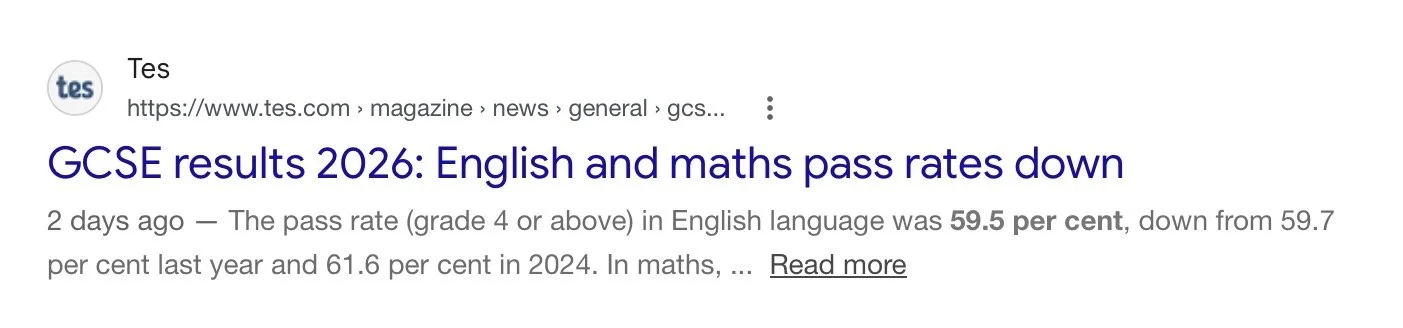
“English and maths pass rates are falling.”
So this is true of the all-ages figure, i.e. everyone and anyone taking these GCSE exams - in fact it’s down for five years in a row. English from 61.6% to 59.5% and maths from 59.6% to 57.2% since 2024.
However, if we just look at students taking these exams for the first time (in Year 11) English pass rates actually rose this year, from 70.6% to 71.4%. Maths dipped fractionally, from 71.9% to 71.8%, but essentially remained steady.
So, the lower rates are entirely down to retakers rather than falling standards year-to-year.
This is also exactly what you would expect to happen with serial retakers! More students are retaking English and maths every year: 219,135 sat a maths resit this summer, up 6% on 2025; 187,558 sat an English resit, up 7%. Their pass rates are far lower than first-timers’ (15.3% and 19.8% respectively) and falling further. Those that retake multiple times end up skewing data, as they stay in the data for longer, and therefore give a distorted view of pass rates.
If you took a class and averaged their 100m sprint times, but counted the slowest person’s time 8 times and everyone else’s once, you’d get a much lower mean result!
The Sutton Trust’s director of research and policy called the resit trend “very concerning,” and it’s obviously true that we’d like to get those serial retakers through these exams, but the rates-change on its own is actually just what you’d expect to happen even if nothing is fundamentally changing with student-ability levels and teaching.
2. Subject choices shifting
Computing entries fell 7.2%, engineering fell 9.3%, and French fell 5.5%. Business studies rose 8%, statistics rose 11%, and sociology rose 5.2%. OCR's managing director pointed to growing use of AI tools as a likely factor behind the computing decline, warning that a genuine grasp of how software works remains valuable regardless of what AI can now do.
Whilst GCSEs do give students a foundation for A-level, there aren’t too many pathways shut off by subject choices - Computer Science at University, for example, tends to want students to have taken Maths A-level but are fairly ambivalent towards Computer Science at A-level, and pay little regard to the GCSE.
A-level choices are far more important to get right - that’s where students can end up stuck studying a subject they don’t like, or accidentally ruling themselves out of a particular course or university 18 months before they even think about UCAS.
3. “Maths Powerhouse” comments pretty accurate
Maths grades 5 and above rose to 53.8% (from 52.8%), and 7-and-above rose to 22.3% (from 21.5%), nearly a 4% jump (relatively speaking) among 16-year-olds in a single year, bigger than almost any other movement in this year’s data.
Whilst it’s always hard to pinpoint who to credit for results that are fundamentally the culmination of over a decade of schooling, a heavy focus on Maths by both Michael Gove and Rishi Sunak is probably somewhat a contributor to this rise in top grades.
As a core subject, maths has also been the focus of huge numbers of software packages to support homework (and in-class practise). From times-tables games all the way up to GCSE exam-practise, personalised learner pathways and more differentiated practise have given students more tools to revise and improve.
4. The gender gap is now the narrowest this century
Girls still outperform boys at GCSE, but the gap has closed for three years running. This year, 24.4% of girls’ entries were graded 7 or above, against 19.6% of boys’, a gap of 4.8 percentage points. That’s down from 5.1 points in 2025 and 5.7 in 2024.
The movement isn’t dramatic in any single year, and it isn’t girls falling back either: their top-grade share has only eased slightly, from 24.7% in 2024 to 24.4% now. What’s changed is boys, whose top-grade share has crept up each year, from 19.0% to 19.4% to 19.6%, eventually resulting in the narrowest gender gap in top grades this century.
Generally speaking, girls perform better with long-term assessments (e.g. coursework) whilst boys prefer one-off examinations (i.e. all-or-nothing final exams). There has been a shift away from coursework in recent years - a shift which is unlikely to be reversed anytime soon, with the advent of AI - which has likely favoured boys.
One other possible theory I’ve seen is that teenage boys are naturally competitive (albeit late in the day) AND are beginning to believe that they may actually have to compete. Girls, and by extension women, have been outperforming men in school for years, and the gap in the workplace (when men have always been ahead historically) has continually shrunk. We may be seeing boys realising they need to ‘pull their socks up’ and do some work if they want to be competitive in the workplace post-school!
5. Location, Location, Location?
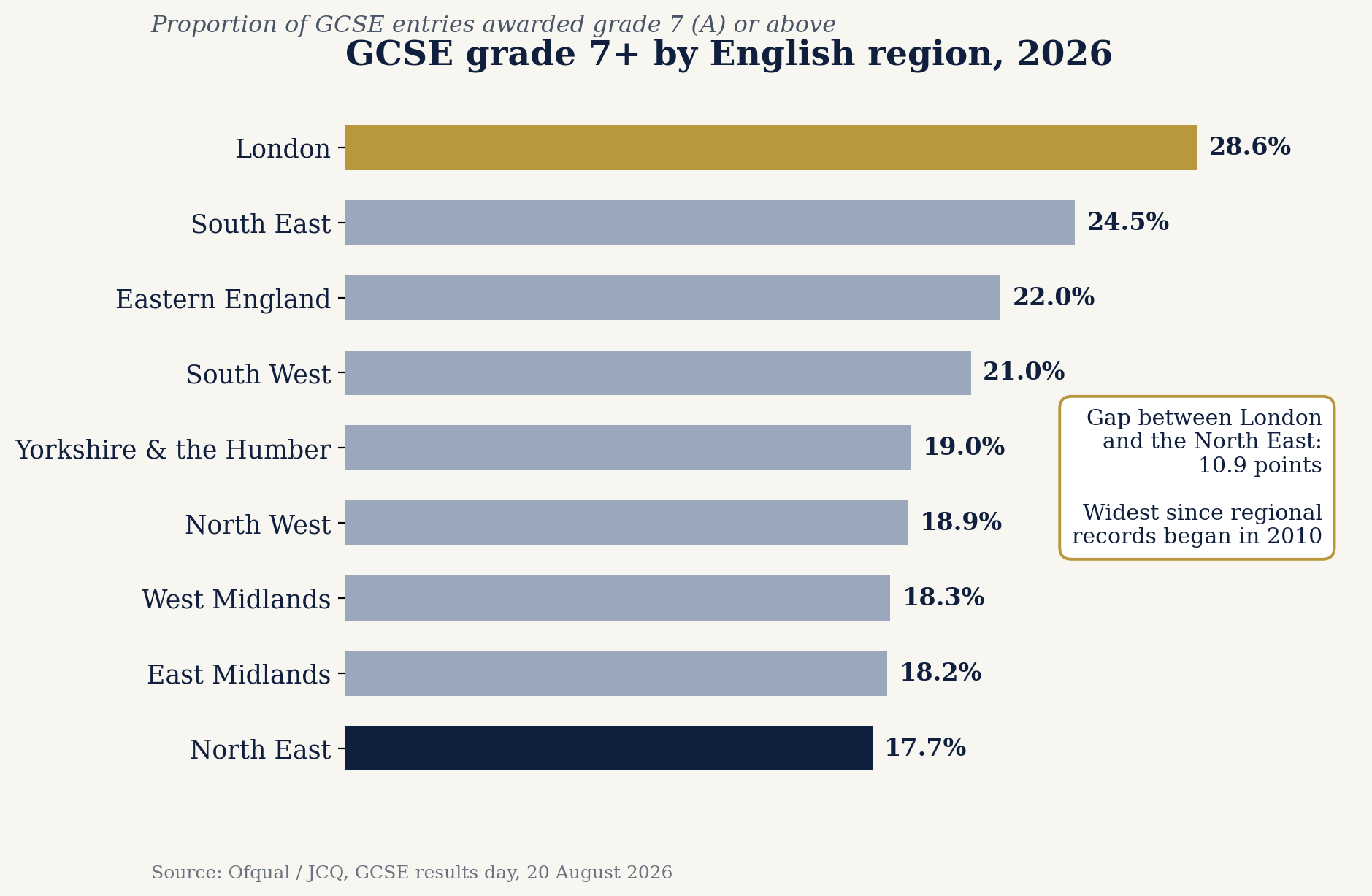
London students achieved grade 7 or above at 28.6%, against 17.7% in the North East, a gap of 10.9 percentage points. That's up from 10.6 points last year, and the widest gap since comparable regional records began in 2010.
Director of the education charity Schools North East Chris Zarraga said: “Schools in the North East are working incredibly hard to overcome those circumstances. But schools cannot independently fix poverty, stretched public services, shortages in SEND support, transport barriers, unequal access to enrichment or very different local economic opportunities.”
It’s certainly true that there are a lot of factors that go into a child’s academic success - even something as small as a child regularly being read to in formative years can have a huge impact. There’s only so much schools can do. It remains to be seen whether the government’s Mission North East education programme will manage to have a big impact on closing this current geographical divide.
So, what should parents do?
None of this changes what's worked for years: consistent, well-targeted 1-to-1 support is the most effective way to improve a child’s attainment level. Whatever age your child, get in touch to discuss how we can best support their individual needs:
Sources:
Ofqual, “Qualification results in England: summer 2026” — https://www.gov.uk/government/publications/qualification-results-in-england-summer-2026/qualification-results-in-england-summer-2026
Ofqual results-day blog, “GCSE, level 1 and 2 results 2026 at a glance” — https://ofqual.blog.gov.uk/2026/08/20/gcse-level-1-and-2-results-2026-at-a-glance-key-trends-and-context-for-teachers/
Tes, “GCSE results 2026: English and maths pass rates down for fifth straight year” — https://www.tes.com/magazine/news/general/gcse-results-2026-english-maths-pass-rates-down
Tes, “Which GCSE subject delivered the most top grades in 2026?” — https://www.tes.com/magazine/news/general/which-gcse-subject-got-best-grades-in-2026
Schools Week, “GCSE results day 2026: 7 key trends from this year’s data” — https://schoolsweek.co.uk/gcse-results-day-2026-6-key-trends-from-this-years-data/
FE Week, “GCSE resits 2026: English and maths pass rates fall as entries surge” — https://feweek.co.uk/gcse-resits-2026-english-and-maths-pass-rates-fall-as-entries-surge/
FFT Education Datalab, “GCSE and Level 1/2 results 2026: The main trends in grades and entries” — https://ffteducationdatalab.org.uk/2026/08/gcse-and-level-1-2-results-2026-the-main-trends-in-grades-and-entries/
ITV News, “Top GCSE grades increase but pass rate falls slightly to pre-pandemic levels” — https://www.itv.com/news/2026-08-20/top-gcse-grades-increase-but-pass-rate-falls-slightly-to-pre-pandemic-levels
Birmingham World, “GCSE results day 2026: West Midlands among England’s worst areas for pass rates” — https://www.birminghamworld.uk/news/gcse-results-day-2026-west-midlands-among-englands-worst-areas-for-pass-rates-8931224
ChronicleLive, North East regional “GCSE coverage GCSE top grades gap from London to North East grows wider amid 'serious problem' warning” — https://www.chroniclelive.co.uk/news/north-east-news/gcse-top-grades-gap-london-34491387
AQA “The Attainment Gender Gap: What role do O levels, GCSEs and Teacher Assessed Grades play?” - https://www.aqa.org.uk/aqi/the-attainment-gender-gap-what-role-do-o-levels-gcses-and-teacher-assessed-grades-play